From Trial Scheme to Policy Tool: The Logic of a Pilot
A policy pilot can reveal where an intervention meets practical limits, helping decision-makers distinguish useful learning from evidence of success.
A policy pilot can look persuasive on a slide: a small programme runs, participants respond, and officials prepare to discuss expansion. But the pilot’s central value is not that it settles whether a policy works. It is that it gives decision-makers a bounded way to learn what happens when an idea meets real conditions, and to decide what the next question should be.
That distinction matters because a trial scheme is often asked to do several jobs at once. It may be expected to test delivery, show public demand, estimate costs, demonstrate fairness, and make a case for wider adoption. A pilot can contribute to these questions, but its design and scale limit what it can establish. Treating it as a miniature version of a full evaluation turns a learning instrument into a verdict it was not built to give.
Why did governments begin using policy pilots?
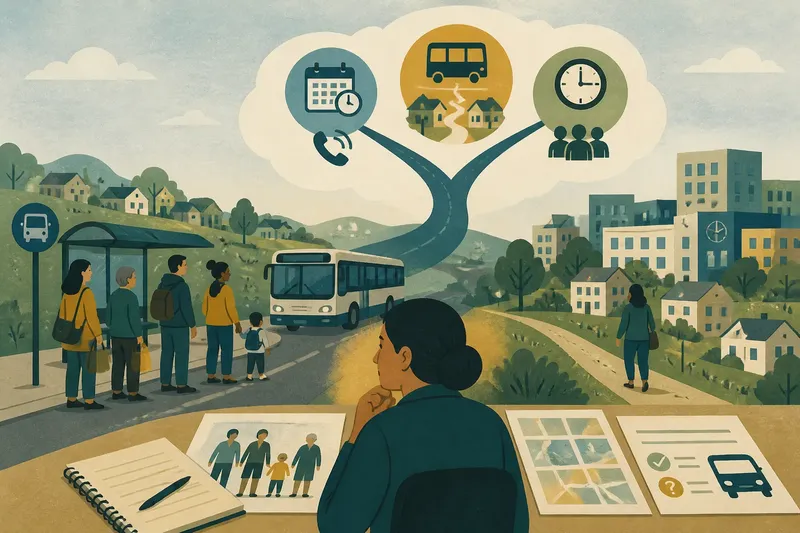
Public programmes have long faced a practical dilemma: a proposal can be coherent on paper and still encounter obstacles once agencies, workers, residents, and existing rules meet it. A limited trial offers a way to examine that encounter before committing to a broader change. The logic is less “try the whole policy on a small scale” than “make uncertainty visible while the decision can still be revised.”
This approach draws on a familiar administrative habit: test a procedure in a controlled setting, inspect what happens, and adjust. In public policy, however, the setting is never fully controlled. A local office may have different staff capacity, community relationships, infrastructure, or partner organizations from another place. The pilot therefore produces knowledge about both the intervention and the conditions around it.
As governments developed more formal approaches to programme planning and assessment, pilots became a recognizable policy tool. They could help identify operational problems, clarify what information to collect, and reveal whether a proposed service was understandable to the people expected to use it. Their appeal was also political and administrative: a limited commitment can be easier to authorize than a permanent, broad change.
That appeal has a catch. Smallness can make a proposal easier to launch, but it does not make the result automatically transferable. A pilot is more like a sample key cut for one lock than a universal key: it can tell you something about fit, while leaving other doors untested.
What can a policy pilot actually teach?
A well-framed pilot can answer questions about feasibility and mechanism. Feasibility concerns whether the programme can be delivered under stated conditions. Mechanism concerns how the intervention is supposed to produce a change: for example, whether a new referral process helps people reach an existing service, or whether an additional service component addresses a particular barrier.
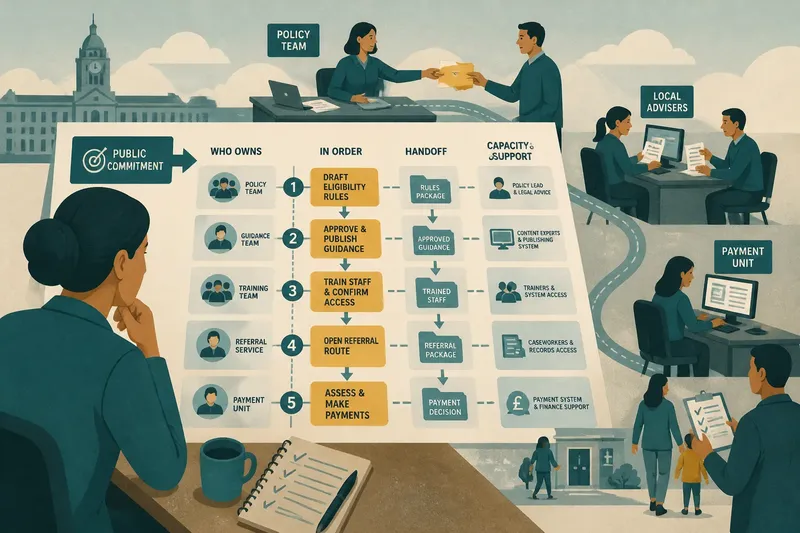
It can also clarify what “delivery” means in ordinary work. A written policy may call for a prompt referral, but a pilot can show whether staff know who initiates it, what information moves with the referral, and how a resident learns what to do next. These are not minor details. They shape what the intervention becomes in practice.
Other useful learning can concern acceptability and adaptation. Participants may interpret a service differently from its designers; frontline workers may make informal adjustments to fit local routines. A pilot can surface those responses and help distinguish a necessary adaptation from a change that alters the intervention’s purpose.
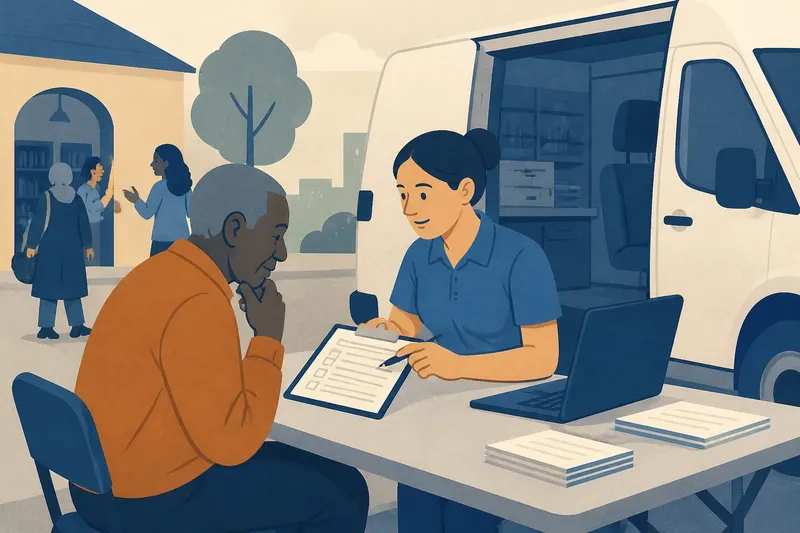
Imagine a municipality considering a mobile enrollment service for residents who have difficulty visiting a central office. It runs a limited trial through neighborhood libraries and records whether staff can complete applications, where residents need help, and which steps cause confusion. The expected observable result is a clearer account of workable locations and process obstacles—not proof that the service will increase enrollment across the municipality.
Why is a pilot not proof of success?
A pilot’s participants, sites, and operating conditions are usually limited by design. Those limits may be appropriate for learning, but they constrain conclusions about effects elsewhere. A favorable response in one setting does not establish that the same intervention will work for people with different needs, agencies with different capacity, or places with different service networks.
Small trials can also produce ambiguous signals. A programme may appear promising because a capable team receives unusually close attention, because participants who opt in are especially motivated, or because a temporary partner provides support that a permanent service would not have. These possibilities do not invalidate the pilot; they identify questions that a wider decision must address.
Nor does a pilot necessarily show that an intervention caused an observed change. If conditions shift during the trial, or if participants receive other services at the same time, it can be difficult to separate the contribution of the pilot from the surrounding circumstances. Establishing effects may call for a different evaluation design, suitable comparison, and enough information to answer the question responsibly.
The word “success” also hides choices. A programme might be easy to deliver yet fail to reach people facing the greatest barriers. It might be welcomed by participants but require staff time that agencies cannot sustain. A pilot can reveal such tensions, but decision-makers need to state which outcomes matter and how competing objectives will be judged.
How should a pilot shape a wider decision?
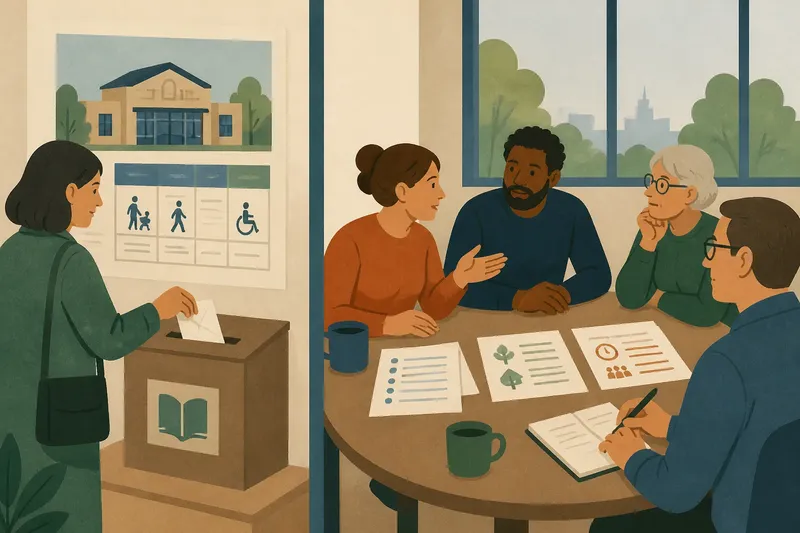
The most useful pilot begins with a decision in view, not with a general desire to “see what happens.” Officials should say what uncertainty matters, what observations could reduce it, and which options remain open afterward. Those options may include expanding, redesigning, extending the learning phase, testing in a different setting, or stopping.
A clear learning plan can be modest without being vague. It should identify the intervention’s essential features, the parts that may adapt locally, the people and settings included, and the information needed to answer the priority questions. It should also record departures from the original plan. Otherwise, a decision-maker may mistake a changed version of the programme for the one initially proposed.
Useful evidence need not be limited to a headline outcome. Administrative records can show where a process stalls; interviews can explain how participants understood a service; staff logs can reveal workarounds; and observation can show how a written procedure unfolds. Each source has limits, so the point is to connect evidence to the question rather than collect data simply because a form exists.
Expansion should be treated as a fresh decision, not as the next automatic stage. It requires asking whether the promising features depend on conditions that can be reproduced, what resources and responsibilities broader delivery would require, and who may be left out. A pilot can narrow uncertainty; it cannot remove the need to make those choices openly.
What questions do readers often ask about policy pilots?
How is a pilot different from a demonstration project?
The terms overlap, and agencies do not always use them consistently. A demonstration project often emphasizes showing how an approach can operate, while a pilot is commonly framed around learning that informs a later decision; the stated purpose matters more than the label.
How large should a policy pilot be?
Its scale should fit the uncertainty being examined and the settings needed to examine it. A small trial may be enough to clarify a confusing form, while questions about delivery across varied agencies may require more than one kind of setting.
When should officials stop or extend a pilot?
They should compare what has been learned with the questions set at the outset, including whether important gaps remain or the design changed in ways that weaken interpretation. Stopping, revising, or extending can each be reasonable decisions; none should be presented as success by definition.
Can a pilot produce evidence about fairness?
It can show who is reached, who encounters barriers, and how the service is experienced across groups included in the trial. A limited set of sites or participants may leave other needs unexamined, so fairness claims should reflect who was actually represented.
What turns a trial into a policy tool?
The distinction lies in how its findings are used. A pilot becomes a policy tool when officials treat it as an organized inquiry tied to a real choice, preserve the difference between observation and inference, and allow the answer to change the proposal. If expansion is already assumed, the trial risks becoming a display of activity rather than a means of learning.
That discipline also makes failure informative. A trial that exposes an unworkable handoff, an inaccessible enrollment channel, or an unmet staffing need may prevent a larger programme from repeating the problem. The result is not a failed policy in miniature; it is information about what the original proposal did not yet account for.
For anyone assessing a policy pilot, the useful question is not simply whether it succeeded. Ask what uncertainty it was designed to reduce, what the trial actually observed, whose experience it included, and what decision followed. Those questions keep the pilot in its proper role: a carefully bounded source of learning, not a shortcut from a promising start to a settled policy.