The Policy Problem Is Already a Design Choice
See how a policy problem definition sets the boundaries of response, and use focused questions to spot whose experience and causes it includes or leaves out.
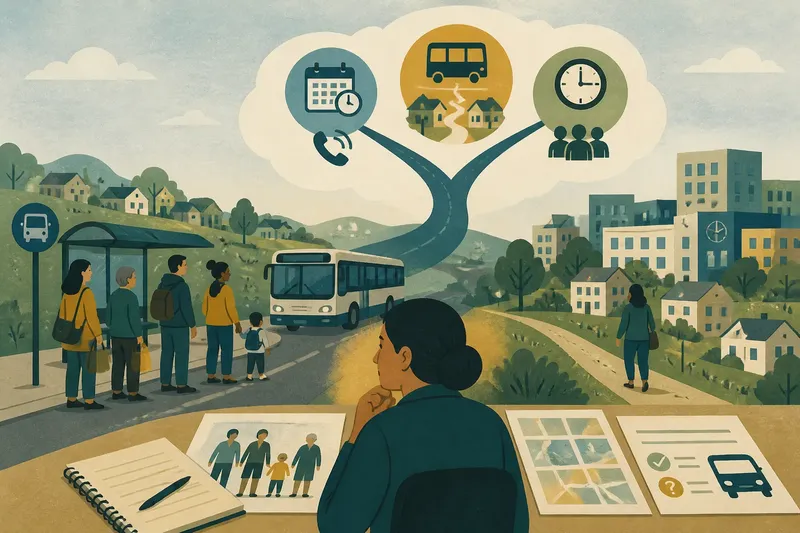
A policy problem definition can decide which responses seem reasonable before anyone compares proposals. In a town where buses run infrequently, officials might describe the issue as “low ridership” or as “unreliable access to work, school, and services.” The first phrase points toward attracting passengers; the second invites questions about routes, schedules, fares, and who depends on the service. The facts may overlap, but the design choices do not.
This is not a claim that every problem statement hides an agenda. It is a reminder that public programmes need boundaries: a named condition, a population, a cause, and some account of what could change. Readers can examine those boundaries without assuming bad faith or accepting the wording as neutral.
What does the problem statement make visible?
Look first for the condition the proposal says needs to change. “Too many missed appointments” names an outcome. “Patients cannot get to clinics” names a possible barrier. “Clinic schedules do not fit shift workers” narrows the account further, toward a specific feature of service design.
Each description can be accurate while drawing attention to different evidence. A statement about missed appointments may lead to reminders and attendance targets. A statement about travel may prompt route or transit questions. A statement about scheduling may raise staffing and opening-hour constraints. The wording does not settle the decision, but it helps decide which questions enter the room.
Watch for a problem defined only by a measurable symptom when the proposed action could affect the conditions behind it. A count can help track a public issue; it cannot, by itself, explain why that issue occurs. Treat the measure as one part of the account, not as the whole account.
Who is inside the stated population?
A definition often identifies a group through an administrative category: households receiving a benefit, students below a threshold, or residents in a particular district. Such categories can make a programme workable. They can also leave out people whose circumstances resemble the target group but whose records, status, or location do not fit the rule.
Ask who is named, who is implied, and who is absent. “Families with young children” may include caregivers beyond parents, while a programme rule may recognize only a particular relationship. “Residents of the service area” may sound broad but depend on a boundary that divides nearby households.
Then ask whether the definition describes people affected by the problem or only people already visible to an agency. Those populations may differ. Records usually reflect contact with a programme, not every person who might need it.
Which cause is being treated as changeable?
Problem statements often move quietly from condition to explanation. A proposal may describe food insecurity as a lack of household planning, a shortage of nearby stores, an income constraint, or some combination. Each account gives a different actor a plausible role and makes some remedies easier to imagine than others.
Separate what is observed from what is inferred. If the statement says that people miss appointments because they forget, ask what supports that explanation and what other barriers could produce the same pattern. If it points to a shortage of services, ask whether availability, eligibility, timing, or distance is meant.
This distinction matters because causes are not always equally within the reach of the programme. A local agency may change appointment reminders more readily than regional transit routes. That practical limit should be stated, rather than smuggled into the definition as though the reachable cause were necessarily the important one.
What does a problem definition leave out?
Use these questions to inspect a proposal’s framing:
- What condition is named? Is it an outcome, a barrier, or an interpretation of why the outcome occurs?
- Who is counted? Does the target group match the people affected, including those absent from agency records?
- Where and when does the problem occur? Does the definition conceal differences across neighborhoods, seasons, or service settings?
- What cause is assumed? Is it supported by the proposal’s account, or simply the cause most convenient for the proposed action?
- Whose costs are described? Does the framing include burdens on residents, frontline staff, and other public services?
- What would count as improvement? Does the stated outcome reflect the problem residents are meant to experience less often?
These are not demands that every proposal address every cause. They help readers distinguish an honest scope choice from an unnoticed gap. A narrow programme can be sensible if its limits are visible and its purpose is not mistaken for a full account of the problem.
How does the wording shape the available response?
Imagine a school district describes frequent student absences as a failure of family attendance habits. It proposes clearer notices and follow-up calls. If the definition instead includes unreliable morning transportation, the district might also examine bus routes and the timing of service. The expected observable difference is not a promised change in attendance; it is that the second framing makes transportation evidence and route decisions relevant to the discussion.
The distinction resembles choosing which drawer to use in a filing cabinet: the papers do not change, but what can be found together does. In policy, the chosen drawer may determine which agencies are consulted, which options receive attention, and which outcomes later appear relevant.
When reading a proposed response, trace it backward. Ask which sentence in the problem definition makes that response seem appropriate. If the connection is hard to see, the proposal may be responding to a different issue than the one its opening language claims to address.
What should readers ask about the evidence?
Evidence can describe the scale or pattern of a condition, but it does not automatically select the right definition. A service-use count may reveal where demand is recorded; it may not show who cannot reach the service. A complaint record can identify recurring concerns; it may underrepresent people who do not know where to complain or expect a response.
Ask what the evidence can establish and what it cannot. Look for differences between a direct observation, an administrative category, and an explanation of cause. If a proposal moves between these without saying so, its problem definition may sound more settled than its supporting information warrants.
Also notice what information would change the framing. If the answer is “nothing,” the definition may be functioning as a fixed assumption rather than a working account. If a plausible finding could alter the target group or cause, the proposal should make room for that possibility.
Which questions help test a policy problem definition?
Can one problem have more than one valid definition?
Yes. A condition can be described through its outcome, its causes, or the barriers people face, and those descriptions may all capture part of the issue. The useful question is which definition fits the proposal’s purpose and what it leaves beyond scope.
Does a narrow definition always mean a weak policy?
No. A limited programme can address a specific barrier without claiming to resolve every contributing cause. Its scope should be explicit so readers can judge the response against the problem it actually undertakes.
How can readers spot an assumption about cause?
Look for language that turns a pattern into a reason, such as saying a service is underused because people lack information. Ask whether other explanations could produce the same pattern and whether the proposal distinguishes evidence from inference.
What if the proposal defines the issue only through a target?
Ask what condition that target is meant to improve and how it relates to people’s experience. A target can organize action, but it should not stand in for a clear account of the public problem.
When is the boundary honest enough?
A useful definition does not need to settle every dispute before action begins. It should make its main choices legible: the condition of concern, the people and settings included, the causes treated as relevant, and the limits of what the proposed response can address.
When you read a policy problem definition, follow its nouns and omissions as carefully as its promised remedies. The main search phrase, policy problem definition, points to a practical reading task: identify the boundary, then ask who benefits from seeing the problem inside it and who remains just beyond its edge.
That last question is often more useful than asking whether the wording is neutral. No description is complete; the public value lies in making the chosen boundary visible enough to question, revise, or defend.